Some of the most important decisions in a career are made not when everything is going well, but when something changes.
- A new context in the company,
- A restructuring,
- A personal change
- Or simply the feeling that your career is no longer moving in the right direction.
In those moments many people realize something: advancing professionally is not always about working harder, but rather about gaining perspective and strategically deciding what the next step should be.
That is the type of process that I accompany with my clients today.
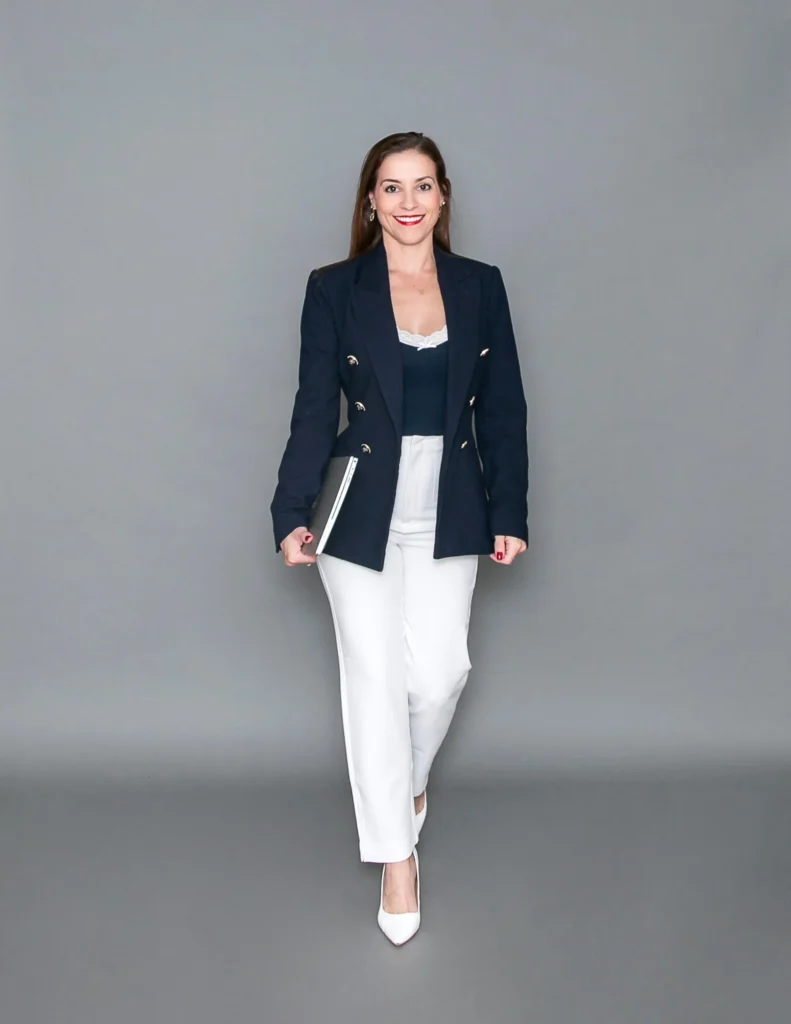
Hi, I'm Erica Lais.
I am a career and life coach.
For more than 16 years I developed my career in the corporate world, mainly in the financial and digital business sector, working in global institutions such as Citibank and HSBC.
Throughout that journey I worked in different areas related to strategy, business growth and digital transformation, and in the last years of my corporate career I held management positions leading business initiatives and digital development.
I have also had the opportunity to live in five countries: Brazil, Mexico, the United States, Singapore and Germany, which has allowed me to develop an international perspective on professional development, leadership and career decisions.
But perhaps the most important thing is that my trajectory never followed a single line.
Over the years I made several professional transitions, moving between different roles, projects and contexts.
What all of those decisions had in common was something that over time became central to my career thinking:
They were intentional decisions.
What I learned from my own career transitions
After experiencing several different professional stages, I understood something important.
Careers rarely develop in a linear fashion. There are often times when we need:
- Take distance to understand where we are
- Redefine our professional priorities
- Reposition our experience
- Decide what the next chapter of our career should be
In those moments, having clarity and strategy makes all the difference.
My methodology
From that experience I developed the Strategic Career Repositioning (SCR) Method™, a methodology designed to help professionals move from uncertainty to control over their career.
The method is based on three key stages
Clarity
Understand your current professional situation and define the right direction for your next stage.
Positioning
Strengthen your professional profile and build a clear narrative about your experience and value.
Motion
Activate specific opportunities inside or outside your organization.
Training
My work combines professional experience, strategic training and personal development tools.
I am certified as a Certified Professional Life Coach by the Certified Professional Life Coach Institute (US), a training that allowed me to develop tools to accompany processes of clarity, decision making and personal transformation.
In parallel, my academic training includes an MBA from the Kellogg School of Management and the Chartered Financial Analyst (CFA) certification, which have deeply influenced my way of thinking about strategy, finance, business and professional development.
Over the years I have also dedicated time to studying and working with personal development and self-knowledge tools, because I believe that career decisions are not made solely from professional logic, but also from a deeper understanding of who we are and the type of life we want to build.
My Purpose
- Throughout my career, I've seen many talented professionals reach moments of professional uncertainty.
- People with solid track records who, nevertheless, feel their career needs a new direction or strategic repositioning.
- In many cases, the problem isn't a lack of talent or experience.
- The challenge is often a lack of clarity about the next step or how to position themselves for new opportunities.
- I firmly believe that a career should not only allow us to develop professionally but also to build prosperity, stability, and the opportunities we want to create in our lives.
- When we make career decisions with clarity and intention, it not only changes our professional trajectory but also the opportunities, impact, and resources that career can generate over time.
- That's why my work consists of helping professionals make more conscious career decisions so they can build a path that combines professional fulfillment, growth, and prosperity.
CTA
If you are going through a time of professional transition or simply want to explore new possibilities in your career, we can start with a conversation.